
Click here to get back to the main LCC12 page
We are delighted to host the 12th Language Creation Conference in Copenhagen, Denmark. This page will be updated with everything we want you to know before making the trip to Copenhagen.
Setting
Søndre Campus
Søndre Campus /ˈsønɐ ˈkʰampus/ (also known as “KUA” (Københavns Universitet på Amager ‘University of Copenhagen on Amager’)), one of several campuses under the University of Copenhagen, houses the Faculty of Law, the Faculty of Humanities, and the Faculty of Theology. It is situated on the northwestern side of the island Amager /ˈama̰ː/, right next to the Islands Brygge metro station, which is on the M1 line of Copenhagen’s metro network, and is furthermore connected to the rest of the city via several frequently departing bus routes, such as the 5C route. This makes it very easy to get back and forth between Søndre Campus and the inner city, with connections to major hubs such as Nørreport, Kongens Nytorv, and Copenhagen Central Station.
Click here for a map of Søndre Campus. Despite the Department of Nordic Studies and Linguistics being located in building 22, the majority of the conference will take place in building 4A (room 4A.0.69). The large “M” in the top left corner of the map is the location of the Islands Brygge metro station.
Traveling to Denmark
Visa
EU citizens are permitted entry into Denmark without a visa. Certain countries outside the Schengen Area require a visa in order to enter Denmark. This site gives a list of all the countries of origin that require a visa for entry into Denmark, and those that do not. If you want to apply for a visa, go to this site.
By plane
Copenhagen Airport (CPH) is the only major international airport in Denmark. The airport, like Søndre Campus, is situated on Amager, which is part of the greater Copenhagen area. If you intend to fly to Copenhagen, you’ll want Copenhagen Airport as your destination. The airport is comparatively small, and every terminal can be reached on foot or with the assistance of an airport worker.
By train
If you arrive in Copenhagen by train from another country, you will either be going through Germany or Sweden. All trains to and from Sweden stop at Nørreport /ˈnɶːɐpʰoɐ̰t/ station and/or Copenhagen Central Station. Both stations are connected to Islands Brygge station by the Copenhagen metro network.
Copenhagen
Here’s a map of a handful of important locations and potential points of interest in Copenhagen (as well as in Roskilde and Lejre).
Staying in Copenhagen
There exists a multitude of lodging options in Copenhagen, from cheap communal dorm hostels to high-end luxury hotels, and everything in between.
As part of a deal with the hotel chain Go Hotel, LCC12 attendees can use the discount codes City10 and Copenhagen10 for 10% off their bookings at the Go Hotel “City” and Go Hotel “Copenhagen” locations (these are both marked on the map above).
Getting around Copenhagen
By public transport
The various areas of Copenhagen are connected mainly by four metro lines and loads of busses. You can read all about the metro system here, and this page should contain everything you need to know about public transport in general. If you plan on using public transport to get around Copenhagen, we recommend downloading the app “Rejseplanen”, where you can see the fastest route between any two points. You can also access “Rejseplanen” as a website here.
In order to ride public transport, you must have a valid ticket. Tickets are not required to physically get onto trains and busses: There are no physical barriers or gates that you have to cross in order to get to train platforms, nor will bus drivers ask you to show your ticket. Instead, random routine ticket checks are carried out by personnel on the busses and trains themselves. If you do not show a valid ticket, you will be liable to pay a fee ranging from 750,- to 1000,- kr., depending on the company operating the service.
Tickets can be bought in the “Rejsebillet” app. As an alternative, you may use the “Rejsekort” app, where you simply swipe to begin your journey and then swipe again at the end of your journey; the app then automatically calculates the price and charges the money from your account.
If you’re planning on traveling around Copenhagen and beyond, we recommend getting a City Pass, which can be bought through the “Rejsebillet” app. The City Pass allows you to travel freely for a chosen number of days within the area designated by the type of City Pass you’ve purchased.
By bicycle
Copenhagen accommodates bicycles with bicycle lanes virtually everywhere. Biking is by far the most common way of getting around for Copenhageners. Bicycles can be rented through various services, such as Donkey Republic.
It is not recommended that you ride bicycles in Copenhagen if you do not routinely ride bicycles in your daily life, especially during rush hour.
When riding a bicycle in Denmark, you use your arms to signal to pedestrians, drivers, and other bicyclists what you’re doing: Extending your left/right arm to the left/right indicates that you are about to turn left/right. To indicate that you are about to brake, you hold up your hand (as if taking a vow; preferably your left hand).
By foot
The inner city is compact. Virtually no two parts of the inner city are farther than 60 minutes apart if you’re traveling on foot. Even the walk from Copenhagen Central Station to Søndre Campus is less than 30 minutes. While it may not be an ideal way to get around Copenhagen, it is certainly a viable method.
By car
It is not recommended that you drive a car in Copenhagen if you are not used to navigating a compact city with bicyclists around you at virtually all times.
Safety
In the following subsections we hope to address any concerns you may have about staying safe while visiting Copenhagen.
LGBTQ+
Denmark is ranked among the safest countries in the world for LGBTQ+ people. There are few, if any, areas in Copenhagen where queer persons are likely to face discrimination or feel unsafe as a result of their sexuality or gender identity.
Late at night, certain areas in the western and northwestern periphery of Copenhagen, such as Glostrup, Albertslund, Nørrebroparken, or Brønshøj, may feel unsafe, and while this is true for queer as well as non-queer people, these areas have no reputation of queer-targeted crime or discrimination in particular.
Crime
Copenhagen is generally regarded as a safe city. Serious crime is uncommon. The most common form of crime in Copenhagen is pickpocketing, which can be more or less entirely avoided by staying aware of your personal items. Pickpockets operate primarily in crowded areas, particularly at night. The streets Strøget and Gothersgade can be rather crowded at night, as can train stations and the metro during rush hour. You can always contact the police by calling 114. For emergencies, call 112.
Freetown Christiania (or Fristaden Christiania), often simply known as Christiania, is an anarchist commune and micronation in the Christianshavn area of Copenhagen. It is a popular tourist destination, but while virtually no one will experience any significant problems while visiting Christiania, it should be noted that it has a history of predominantly non-violent drug-related crime.
Money
Currency
The Danish currency is the krone /ˈkʰʁoːnə/, plural kroner /ˈkʰʁoːnɐ/, abbreviated as kr., code DKK. The word krone is a noun meaning ‘crown’; saying crown and crowns instead of krone and kroner is perfectly acceptable and will be understood by virtually everyone. The Danish krone has a subunit called the øre, plural ører (both /ˈøːɐ/), equal to one 1⁄100 of a krone. A comma separates kroner from ører: 2,49 kr. is 2 kroner and 49 ører. A price with no ører often uses a dash in place of double zeros: 3,- kr. is 3 kroner.
When a cashier calls out the total during checkout, it is common to round off the total to units of 0,50 kr. For example, you may be paying 10,79 kr., but the cashier will say 11 kroner /ˈɛlvə ˈkʰʁoːnɐ/; or you may be paying 9.46 kr., but the cashier will say 9 kroner og 50 ører /ˈnḭː ˈkʰʁoːnɐ ɐ hælˈtsʁæs ˈøːɐ/. When paying with a card, you will pay the actual total. When paying with cash, you will be paying the rounded-off amount.
Tipping
Denmark does not have a tipping culture. Danish service workers earn hourly wages and do not depend on tips. Tipping is not required or expected. Some restaurants have begun giving guests the option to tip, but this has been received very poorly by Danish people.
Pant
Do not put away cans and bottles in the trash. When you buy beverages in Danish stores, many of them will have pant /ˈpʰæn̰t/. Pant is a deposit that you pay when you buy things like cans and bottles. There are three tiers of deposits: A (1,00 kr., cans and glass bottles under one liter), B (1,50 kr., plastic bottles under one liter), and C (3,00 kr., anything over one liter). So when you purchase a can of beer that costs 8,00 kr. (about €1.07 or $1.22), you will actually be paying 9,00 kr. at checkout. Below is an example of how a plastic bottle with tier B pant might be marked:

Once the can or bottle is empty, you can deliver it at a grocery store deposit station, which will give you a coupon for an amount equal to the total pant of all the cans/bottles you have handed in. You can then use that coupon to pay at checkout in the grocery store, or you can ask to have the amount given to you in cash.
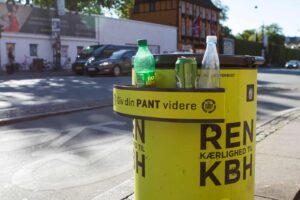
If you do not want to hold on to empty bottles and cans, you can leave them next to public trash cans (some even have little shelves specifically to put pant in, as depicted below). People in need will come to pick them up.
Cultural notes
Drinking culture
Public drinking and public intoxication is legal and common in Denmark. If you are outdoors during the evening hours, you can expect to see tipsy people. Public intake of alcohol is not stigmatized, nor is it exclusive to or even especially associated with individuals suffering from substance abuse or addiction: As such, there is no reason to be particularly alarmed if approached by an intoxicated individual in Copenhagen.
Public transport culture
Excluding bicycles, public transport such as metro, bus, and train, are the main modes of transport for people living in Copenhagen.
When getting on public transport, you must wait for passengers getting off. On metro and trains, wait by standing by the sides of the doors, letting all passengers get off before attempting to enter. Attempting to enter head-on while passengers are still getting off, is considered extremely impolite.
When exiting public transport, especially the metro, make sure to indicate clearly that you are about to get off by approaching and facing the door. This way, people who are about to board the metro will know to wait for you to exit before entering.
When using an escalator, make sure to stand to the right to make room for people who may be in a hurry walking up/down the escalator. If someone is standing in your way on the escalator, it is perfectly acceptable to say undskyld /ˈɔnskyl̰/ ‘excuse me’ and/or very gently tap them on the shoulder to let them know that you’d like to walk past them.
Public nudity
Public nudity is legal in Denmark. At beaches and other popular swimming spots in Copenhagen, such as Kalvebod Bølge, it is common to encounter nude people, especially during the summer. It is considered impolite (and may be circumstantially illegal) to take photos of swimmers—clothed or not—without their consent.